Mikhail Bakunin
Biography
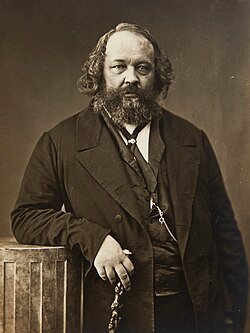
Mikhail Alexandrovich Bakunin (1814–1876) was a Russian revolutionary, political theorist and one of the most influential figures in the development of anarchism. He was born at Pryamukhino, his family’s estate in the Tver Governorate of the Russian Empire, into a landowning aristocratic family. As a young man he entered military training and served briefly as an artillery officer, but resigned from the army in 1835. He subsequently became involved in the intellectual circles surrounding German idealist philosophy and helped introduce the work of Hegel to Russian readers.
Bakunin left Russia in 1840 and studied in Berlin before moving through Switzerland and Belgium to Paris. There he associated with political émigrés and radical thinkers, including Pierre-Joseph Proudhon, Karl Marx and members of the Polish independence movement. During this period he moved from philosophical radicalism towards revolutionary politics. His public opposition to the Russian Empire led the imperial government to order his return and, when he refused, to confiscate his property and strip him of his status.
The European revolutions of 1848 drew Bakunin into a series of revolutionary movements. He participated in the Slav Congress and the Prague uprising, advocated a federation of liberated Slavic peoples and later joined the Dresden uprising of May 1849. After the uprising was defeated, he was captured and twice sentenced to death—first in Saxony and then in Austria—although both sentences were commuted. Austrian authorities transferred him to Russia in 1851.
Bakunin spent years imprisoned in the Peter and Paul Fortress and the Shlisselburg Fortress. While imprisoned, he wrote the document later published as his Confession at the request of Tsar Nicholas I. In 1857 he was exiled to Siberia. He escaped in 1861, travelling through Japan and the United States before reaching London, where he rejoined the community of Russian political exiles around Alexander Herzen and Nikolay Ogarev.
During the 1860s Bakunin developed the ideas for which he became best known. He rejected the state, hereditary privilege, organised religion and political systems governed by a permanent ruling minority. In their place he advocated a social revolution based upon collective ownership, workers’ and peasants’ associations, local autonomy and federation from below. His position is generally described as collectivist anarchism or revolutionary socialism. Unlike advocates of an individualist society, Bakunin regarded social freedom as something that could be realised only through the freedom and equality of all.
Bakunin joined the International Working Men’s Association, commonly called the First International, in 1868. He and his supporters became influential particularly in Switzerland, Italy and Spain. Increasing disagreements developed between the federalist and anti-authoritarian currents associated with Bakunin and the General Council associated with Marx. Their dispute concerned political organisation, the role of the state, participation in electoral politics and the authority exercised by the General Council. At the Hague Congress of 1872, Bakunin and James Guillaume were expelled from the International. The split became an important event in the historical separation of anarchist and Marxist tendencies within the socialist movement.
Bakunin continued to take part in revolutionary efforts, including an unsuccessful insurrection at Lyon in 1870 and preparations for an uprising at Bologna in 1874. Much of his writing remained fragmentary, and several of the works most closely associated with him were edited or published only after his death. His major texts include Federalism, Socialism and Anti-Theologism, The Knouto-Germanic Empire and the Social Revolution, Statism and Anarchy and the posthumously published fragment known as God and the State. He wrote principally in French and Russian, as well as German.
Bakunin’s political legacy also contains serious contradictions and objectionable elements. Although he argued passionately against racial domination and national oppression, some of his polemics against Marx and others employed explicit antisemitic stereotypes and conspiracy claims. These passages form a significant and indefensible part of his record and have been criticised both by later historians and by anarchists. His appetite for clandestine revolutionary organisations has likewise generated continuing debate over the relationship between his libertarian aims and some of his proposed organisational methods.
In declining health, Bakunin withdrew from active political life during his final years. He died in Bern, Switzerland, on 1 July 1876. His advocacy of anti-authoritarian socialism, federalism and popular revolution profoundly influenced the anarchist movements that developed after his death, while his conflicts with Marx shaped debates about political power, party organisation and the state across the international socialist movement.