Nicholas Barbon
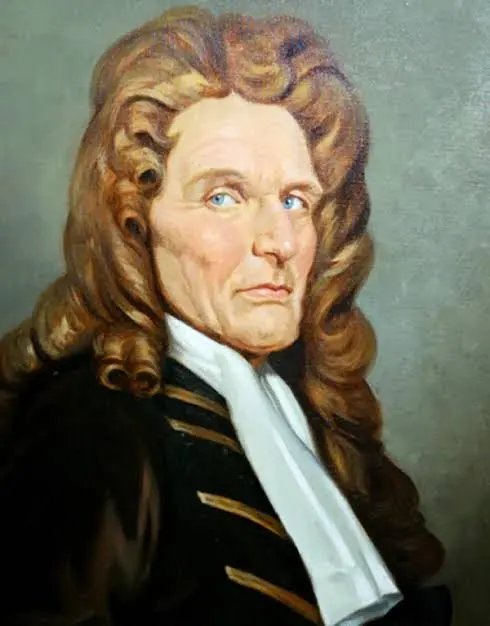
Biography
Nicholas Barbon (1637–1698) was an English political economist, physician, property developer, financier and politician. Born in London, he was probably the eldest son of Praise-God Barebone, the radical preacher and leather seller whose name became attached to the Nominated Assembly of 1653. Barbon studied medicine at Leiden and received his doctorate from the University of Utrecht in October 1661. He was admitted as an honorary fellow of the College of Physicians in 1664, although commerce and building, rather than medical practice, came to dominate his career.
Following the Great Fire of London in 1666, Barbon became one of the city's most prominent speculative builders. He purchased land, divided estates and constructed houses beyond the old boundaries of the City of London, helping to drive the westward expansion of the metropolis. His methods repeatedly brought him into conflict with neighbouring landowners, lawyers and public authorities. A dispute over his development of Red Lion Fields culminated in a violent confrontation between his workmen and members of Gray's Inn in 1684.
The danger of fire to the rebuilt city also provided Barbon with a new commercial opportunity. In 1680–81 he and a group of associates established an Insurance Office for Houses, among the earliest successful English businesses devoted to insuring buildings against fire. The office employed its own men to help extinguish fires and marked insured properties so that they could be identified. Barbon also developed mortgage and credit arrangements that helped finance his building projects, linking property development with emerging forms of insurance and banking.
Barbon defended the enlargement of London in A Discourse Shewing the Great Advantages that New-Buildings and the Enlarging of Towns and Cities Do Bring to a Nation (1678) and An Apology for the Builder (1685). Against complaints that new construction drew people and wealth away from the countryside, he argued that building generated employment, encouraged trade and increased national prosperity. These writings grew directly out of his commercial interests, but they also anticipated the broader economic arguments of his later work.
His principal work of political economy, A Discourse of Trade (1690), rejected the idea that a country's gain in commerce must necessarily be another country's loss. Barbon treated wants as the source of exchange and argued that the value of goods depended upon their usefulness and scarcity rather than simply upon the labour or expense involved in producing them. He emphasised consumption, fashion and the continual replacement of goods as forces sustaining trade. Although Barbon is often placed among the mercantilists, his criticism of restrictions upon trade and of the doctrine of a permanently favourable balance of trade set him apart from important currents commonly grouped under that label.
During the recoinage controversy of the 1690s, Barbon opposed the monetary arguments of John Locke. In A Discourse Concerning Coining the New Money Lighter (1696), he denied that silver possessed an unchanging intrinsic value and argued that money derived its practical value substantially from public authority and accepted use. He supported reducing the silver content of the coinage, believing this would increase the supply of money and ease economic distress. He also participated in schemes for a land bank intended to issue credit secured upon land, although these projects did not produce a stable institution.
Barbon represented Bramber in the parliaments elected in 1690 and 1695. His parliamentary career remained closely connected to contemporary controversies over trade, credit, land and currency. By the time of his death in 1698, his extensive and highly leveraged ventures had left his financial affairs deeply entangled, but his activity had helped reshape parts of London and establish fire insurance as a commercial enterprise.
Barbon's writings occupy a distinctive place in the development of political economy between the seventeenth-century debates over trade and money and the later classical economists. His explanations were neither systematic nor free from the interests of a speculator defending his own projects. Nevertheless, his treatment of demand, scarcity, consumption, credit and money challenged several prevailing economic assumptions and made him an important early critic of restrictive commercial doctrine.