Ferdinand Lassalle
Biography
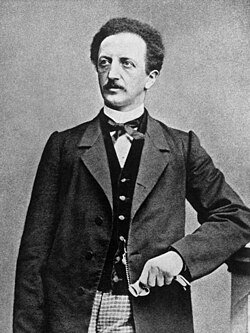
Ferdinand Lassalle (1825–1864) was a German socialist political activist, writer, philosopher and jurist who played an important role in the emergence of an independent workers’ movement in Germany. He was born Ferdinand Johann Gottlieb Lassal in Breslau, then part of Prussia, into a prosperous Jewish merchant family. As a young man he studied philosophy and philology at the universities of Breslau and Berlin, became strongly influenced by Hegel and developed an ambition to combine intellectual work with political action. He later adopted the spelling “Lassalle” for his surname.
Lassalle first attracted wide attention through his involvement in the long legal struggle of Countess Sophie von Hatzfeldt. She was attempting to secure control of property withheld from her during her separation from her husband, and Lassalle took up her case in the 1840s. He investigated her husband’s financial affairs, organised the legal campaign and defended her interests through numerous court proceedings. The dispute continued for years and ended in a favourable settlement for the countess, who became Lassalle’s political supporter and provided him with financial security.
During the revolutions of 1848, Lassalle became active in the democratic movement in the Rhineland and associated with Karl Marx and Friedrich Engels. He spoke publicly, helped organise resistance to the Prussian authorities and supported the Neue Rheinische Zeitung. Arrested in 1848 on charges connected with revolutionary agitation, he was acquitted of the most serious accusation but subsequently imprisoned for encouraging armed resistance. His relationship with Marx and Engels continued after the defeat of the revolutions, although it was marked by political disagreements, personal tensions and periods of cooperation.
Alongside his political activity, Lassalle pursued historical, legal and philosophical work. His publications included a substantial study of the ancient Greek philosopher Heraclitus and The System of Acquired Rights, an examination of legal rights and social development. His approach remained strongly shaped by Hegelian philosophy, particularly the conception of historical development through conflict and contradiction.
In the early 1860s Lassalle became increasingly involved in efforts to organise workers independently of the liberal middle class. In his Open Letter of 1863, addressed to a workers’ committee in Leipzig, he argued for universal and equal suffrage, independent working-class political organisation and the establishment of producer cooperatives supported by state credit. He maintained that trade-union and wage struggles alone could not overcome what he called the “iron law of wages”, under which competitive pressures tended to hold workers’ earnings near the cost of subsistence.
In May 1863 Lassalle helped establish the General German Workers’ Association and became its first president. The organisation was one of the earliest lasting workers’ political organisations in Germany and an important predecessor of the Social Democratic Party of Germany. Lassalle favoured a highly centralised organisation under strong presidential leadership, a model criticised by some other socialists. His supporters became known as Lassalleans, and their ideas remained a distinct tendency within the German workers’ movement after his death.
Lassalle’s political strategy differed significantly from that of Marx. He treated universal suffrage as a central means through which workers might gain political power and obtain state assistance for cooperative production. He was also willing to negotiate with the conservative Prussian minister-president Otto von Bismarck, believing that pressure from the workers’ movement might encourage the monarchy to introduce suffrage or measures directed against the liberal bourgeoisie. Their private conversations did not produce an agreement, but their existence later generated lasting controversy over Lassalle’s political judgement and his conception of the state.
Lassalle was an energetic and charismatic speaker whose agitation helped bring questions of class and independent workers’ politics to a much wider audience. At the same time, his authoritarian style of leadership, tactical approach to the Prussian state and economic arguments were criticised by Marx, Engels and other contemporaries. Marx rejected the “iron law of wages” as Lassalle formulated it and strongly opposed reliance upon state-sponsored cooperatives granted from above.
In 1864 Lassalle became involved with Helene von Dönniges and sought to marry her against the wishes of her family. After she renounced the relationship under family pressure, Lassalle challenged her eventual fiancé, the Romanian nobleman Iancu Racoviță, to a duel. Lassalle was mortally wounded near Geneva on 28 August and died at Carouge three days later, on 31 August 1864. He was 39 years old.
Despite his short political career, Lassalle exerted a substantial influence on the organisation and language of German social democracy. The association he founded later combined with the Social Democratic Workers’ Party associated with August Bebel and Wilhelm Liebknecht, contributing to the formation of the party that eventually became the SPD. His legacy remains contested: he is remembered both as a pioneer of independent working-class political organisation and as an advocate of centralised leadership and state-oriented tactics that other socialist traditions rejected.