Pierre-Joseph Proudhon
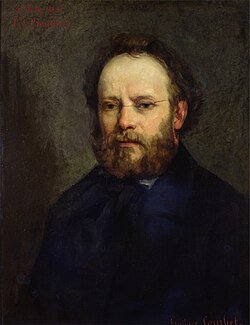
Biography
Pierre-Joseph Proudhon (1809–1865) was a French socialist political theorist, journalist and one of the earliest major thinkers associated with anarchism. He was born in Besançon into a poor working family and received a scholarship to attend the town’s college, but financial hardship prevented him from completing a conventional education. As a young man he became a printer and proofreader, occupations through which he continued his education and encountered a wide range of religious, philosophical and political writing.
Proudhon achieved national attention with What Is Property?, published in 1840. In it he gave the celebrated answer “Property is theft” and openly described himself as an anarchist. His argument was not against every form of personal possession: he distinguished possession based upon use from property that enabled an owner to draw rent, interest or profit from the labour of others.
While working in Lyon during the 1840s, Proudhon developed relationships with workers’ mutual-aid associations and elaborated the ideas later called mutualism. His System of Economic Contradictions, or The Philosophy of Poverty appeared in 1846. Proudhon had corresponded with Karl Marx, but their political and intellectual differences became an open rupture when Marx answered the book with The Poverty of Philosophy in 1847.
Following the French Revolution of 1848, Proudhon edited several radical newspapers and was elected to the Constituent Assembly as a representative for the Seine. He criticised the new republican government and proposed a levy upon rent and interest. He also attempted to establish a People’s Bank that would provide mutual credit at little or no interest, allowing workers and independent producers to exchange their products without dependence upon capitalist financiers. The project attracted interest but never acquired the resources needed to operate as intended.
In 1849 Proudhon was sentenced to three years’ imprisonment for press attacks upon President Louis-Napoléon Bonaparte. He continued to write and publish while imprisoned and married Euphrasie Piégard during this period. After Louis-Napoléon’s 1851 coup established an increasingly authoritarian regime, Proudhon remained critical of dictatorship but also tried to interpret the social forces that had enabled Bonaparte’s rise.
Proudhon opposed both capitalist private property and state-administered communism. He envisioned a society constructed through voluntary agreements among workers, artisans and producers’ associations, supported by mutual credit and organised through federation rather than a sovereign central state. His position changed in important respects over time, but reciprocity, decentralisation and the balancing of social forces remained recurring themes throughout his work.
The publication of Justice in the Revolution and the Church in 1858 brought another sentence of imprisonment. Proudhon escaped to Belgium, where he remained until returning to France in 1862. In The Principle of Federation, published in 1863, he argued that political units should enter limited agreements while retaining substantial autonomy, developing ideas that influenced later federalist and anarchist movements.
His egalitarian criticism of economic domination coexisted with profoundly reactionary positions. Proudhon defended patriarchal authority within the family, treated women as intellectually and socially subordinate to men, and attacked advocates of women’s emancipation. His private notebooks and parts of his published writing also contain explicit antisemitic claims. These positions were challenged by socialist and anarchist contemporaries and remain indefensible elements of his legacy.
Proudhon died at Passy in Paris on 19 January 1865. His theories influenced mutualism, revolutionary syndicalism, cooperative thought and anti-authoritarian socialism, while his federalism reached movements well beyond anarchism. His legacy remains contested both because of disputes over property, political organisation and class strategy and because of the sharp contradiction between his demands for liberty and equality and the exclusions expressed in his writing.