Georgi Plekhanov
Biography
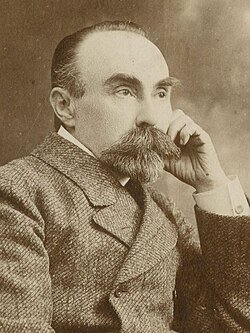
Georgi Valentinovich Plekhanov (1856–1918) was a Russian revolutionary, philosopher and political theorist who played a foundational role in the development of Russian Marxism. Born into a family of the lesser landed gentry at Gudalovka in the Tambov Governorate, he attended military schools and later studied at the Saint Petersburg Mining Institute. He abandoned his studies as his involvement in the revolutionary movement deepened.
During the 1870s Plekhanov became active among the revolutionary populists, or Narodniks, and joined Land and Liberty. In December 1876 he addressed the demonstration outside Kazan Cathedral in Saint Petersburg, one of the first open political demonstrations in modern Russian history. He initially looked principally to the peasantry and village commune as the basis of a future social revolution.
When Land and Liberty divided in 1879, Plekhanov opposed the growing emphasis upon political assassination. The faction associated with him established Black Repartition, while the rival faction formed People’s Will. Facing arrest, Plekhanov left Russia in 1880 and spent most of the following thirty-seven years in exile, principally in Switzerland.
His study of Western European capitalism and the writings of Karl Marx and Friedrich Engels led him to break with Narodnik theory. In 1882 he produced a new Russian translation of the Manifesto of the Communist Party. The following year, with Vera Zasulich, Pavel Axelrod, Leo Deutsch and Vasily Ignatov, he founded the Emancipation of Labour group, generally regarded as the first Russian Marxist organisation.
In works including Socialism and the Political Struggle, Our Differences and On the Development of the Monist View of History, Plekhanov argued that capitalist relations were already developing in Russia and that the growing working class, rather than the peasantry alone, would become the decisive revolutionary force. He defended historical materialism against both Narodnik populism and philosophical idealism, while also writing extensively about art, history and the relationship between individuals and broader social forces.
Plekhanov helped establish the newspaper Iskra in 1900 alongside Vladimir Lenin, Julius Martov and others. At the 1903 congress of the Russian Social Democratic Labour Party, he initially sided with Lenin during the division that produced the Bolshevik and Menshevik tendencies. He soon broke with Lenin over questions of party organisation and became associated with the Mensheviks, although he repeatedly sought unity between the two wings.
During the First World War, Plekhanov adopted a defensist position and supported the Allied war effort, separating him from many other Russian socialists. He returned to Russia following the February Revolution of 1917, supported the Provisional Government and argued that Russia should remain in the war. He opposed the Bolshevik seizure of power in the October Revolution, which he regarded as premature in a country whose capitalist development remained incomplete.
Seriously ill with tuberculosis, Plekhanov moved to Finland during his final months and died at the Pitkäjärvi sanatorium near Jalkala on 30 May 1918. His political positions, particularly after 1903, remained controversial across the socialist movement, but his translations and theoretical writings introduced Marxist ideas to generations of Russian revolutionaries. His account of dialectical and historical materialism exerted a lasting influence upon later Marxist philosophy and also became the subject of continuing debate.